Friday, December 14, 2012

Monday, December 3, 2012
tetrahedral planetoide

Artist: MC Escher
Title: Tetrahedral Planetoide
Escher is officially my favorite drawing artist of all time. The second I saw this I thought "Escher found Atlantis and did not tell anybody!" It is almost like each point has what its adjacent point doesn't have. One has a concave circular stadium type structure, and its adjacent point has a convex dome that counteracts it. What is also cool is the illusion that in one vantage point it actually looks flat (if you focus on just the circle around it). However in another vantage point, when looking at the structures themselves) you can definitely get the 3D feel.
Yet another Escher Drawing=)

Artist: MC Escher
Title: House of Stairs
I chose this drawing for this week's post because I thought it was interesting how he made the stairs go in every direction. Not just left and right in a horizontal/vertical manner, but he also makes then go in and out of the page as well. He also somehow makes a set of stairs look like it doesn't belong while looking at a set of stairs right next to it. And then from another vantage point it looks like those same set of stairs belong more than another set in the entire drawing! And what is up with those alien looking centipedes?! Those along with the stairs make this drawing not only complex but slightly creepy. But I like it!
Friday, November 30, 2012
Almond Blossoms

Thursday, November 29, 2012
Joan Miro

"Venice Twilight" by monet

"Venice Twilight" -1908, oil on canvas
Monet was a founder of French impressionist painting, and the most consistent and prolific practitioner of the movemetns of philosophy of expressing ones perceptions before nature. He was Born in 1840 and died in 1926.This painting was focus on the cathedral and bell tower located on the cost of the island, the beauty of the island at sunset. This was one of Monets greatest series.
Dogs Playing Poker

Georges Seurat

This drawing is called "Place de la Concorde, Winter." It was drawn in the late 1800's. This drawing really emphasizes dark to light and light to dark. It looks like it just snowed and he captured the picture the day after. It is a very simple drawing but covers a lot of elements of art.
Richard Parkes Bonington

Richard Parkes Bonington was one of the great English landscape painters at the height of the grand era of landscape painting in the 1800′s, and a notable figure in the English watercolor movement. I find this painting interesting because it shows the landscape and ships sailing towards it like they are traveling to new lands.
Elaine De Kooning
Sunday Afternoon (1957)
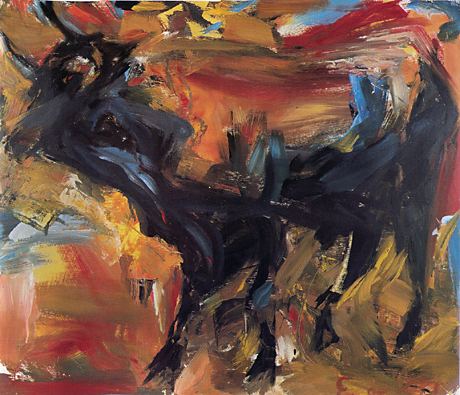
This oil on masonite is meant to be a depiction of a bullfight in Mexico. On a trip there she was captivated by the movements. I love the way that the bull looks like it's standing still and everything around him is moving. The red of the cape and the heat from the ground. Possibly blood from the bull itself.
Op Art

This abstract piece was created by Victor Vasarely. This type of art is referred to as Op art, or optical art. Using simple geometric shapes, like squares and trapezoids, Vasarely is able to create a 2 dimensional design that appears 3 dimensional. In this piece, the square in the middle appears to be jumping off the page. The middle square is the subject of the piece, the part that draws your attention, while the smaller background squares help the piece to appear 3 dimensional. I like how Vasarely uses simple geometric shapes, but combines them in a way that they make a complex and beautiful design. I also like how Vasarely uses simple colors, with each square being outlined and filled in with a different color. For the colors, each one is associated with only one other. The most prominent examples of this are yellow-orange and lite blue-lite green.
Escher Eye

This Piece of art was constructed by M.C. Escher, and can be found today in the National Gallery of Art in Washington. Eye is an excellent example of the technique referred to as globular reflection. This means that when Escher drew this sketch he drew it from looking at it in a reflection. In this case the eye, his own as a matter of fact was drawn from its reflection in a concave shaving glass. He says that he tried to “copy it as faithfully as possible.” Escher felt it was “necessary and logical to convey somebody, an observer reflected in the convex mirror of the eye” and so he decided to draw a skull because again in his own words, “we are all confronted with death whether we like it or not”.
Apocalyptic Landscape

Study of a Standing Male Nude

I like this painting of Gaetano, because the body of the men looks so real. Gaetano applied the right colors for the skin color. Every muscle is well emphasized, it is even possible to the veins. I also like how he applied the light and the shadows on the body exactly where they should be, this therefore know that the men was under a bright light.
Rooms

Title: Rooms
Artist: Toba Khedoori
Medium: Oil and Wax on paper
In order to create this work Toba lays a rag paper on the floor and covers it with thin layers of wax, she then pins it to the wall and etches her images into the wax. This piece reminds me of a vanishing point work. I love how the doors seemingly never end, they just continue on and on.
Wednesday, November 28, 2012
Italian Village Forge

This is a painting done by Heinrich Burkel, and it is called Italian Village Forge, which he created in 1832. Burkel was a very successful landscape artist and he spent two years in Italy, where he created this painting. What I like about this painting is the vivid color and the depth. The background is decorated with mountains, while there is so much detail outside and inside the house.
Chuck Close- Mary Ann Raftery
Chuck Close is a revered American artist who is widely collected by major museums. In the late 1960s, Chuck Close’s realistic and heroically scaled portraits of his family and friends sent shockwaves throughout the art world that are still being felt to this day. Chuck Close's approach to the canvas was inspired by the non-hierarchical, all- over surface of American painting epitomized for him by the work of Abstract Expressionists such as Jackson Pollock. After taking a picture of his subject, Close makes photographic prints that he uses to transfer the images to canvas. Utilizing a technique devised by Renasissance masters and adapted by contemporary billboard paints, Close overlays a working print with a numbered and lettered grid, and then reproduces the image block by block.

Rooftops in the snow

Thursday, November 15, 2012

Artist: MC Escher
Style: Surrealism
I chose this drawing by M C Escher because I feel his art surpasses the rules of physics. When he draws he seems to be able to make his subjects bend, twist, and act opposite of what the mind can comprehend. For example, in this one, he somehow gets the dragon to bite its own tail after it comes through its body and the head goes under and over its own wings! And what is really nice about this drawing is how he makes the background black with some soft white touches to make the dragon this main focal point of the drawing, which really marks the impact of the drawing.
One of van Gogh's
most popular and widely known series are his Cypresses. During the Summer of 1889, at
sister Wil's
request, he made several smaller versions of Wheat Field with Cypresses.[168]
These works are characterised by swirls and densely painted impasto,
and produced one of his best-known paintings, The Starry
Night. Other works from the series include Olive Trees with
the Alpilles in the Background (1889) Cypresses (1889), Cypresses
with Two Figures (1889–1890), Wheat Field with Cypresses (1889),
(van Gogh made several versions of this painting that year), Road with Cypress and Star (1890), and
Starry Night Over the Rhone (1888).
They have become synonymous with van Gogh's work through their stylistic
uniqueness.

Subscribe to:
Posts (Atom)