Thursday, November 29, 2012

Georges Seurat


This drawing is called "Place de la Concorde, Winter." It was drawn in the late 1800's.  This drawing really emphasizes dark to light and light to dark.  It looks like it just snowed and he captured the picture the day after.  It is a very simple drawing but covers a lot of elements of art.

Richard Parkes Bonington


Richard Parkes Bonington was one of the great English landscape painters at the height of the grand era of landscape painting in the 1800′s, and a notable figure in the English watercolor movement. I find this painting interesting because it shows the landscape and ships sailing towards it like they are traveling to new lands.

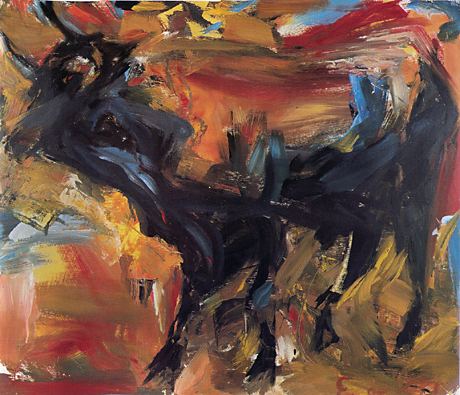
Elaine De Kooning

Sunday Afternoon (1957)


This oil on masonite is meant to be a depiction of a bullfight in Mexico. On a trip there she was captivated by the movements. I love the way that the bull looks like it's standing still and everything around him is moving. The red of the cape and the heat from the ground. Possibly blood from the bull itself.

Op Art


This abstract piece was created by Victor Vasarely. This type of art is referred to as Op art, or optical art. Using simple geometric shapes, like squares and trapezoids, Vasarely is able to create a 2 dimensional design that appears 3 dimensional. In this piece, the square in the middle appears to be jumping off the page. The middle square is the subject of the piece, the part that draws your attention, while the smaller background squares help the piece to appear 3 dimensional. I like how Vasarely uses simple geometric shapes, but combines them in a way that they make a complex and beautiful design. I also like how Vasarely uses simple colors, with each square being outlined and filled in with a different color. For the colors, each one is associated with only one other. The most prominent examples of this are yellow-orange and lite blue-lite green.

Escher Eye


This Piece of art was constructed by M.C. Escher, and can be found today in the National Gallery of Art in Washington.  Eye is an excellent example of the technique referred to as globular reflection. This means that when Escher drew this sketch he drew it from looking at it in a reflection. In this case the eye, his own as a matter of fact was drawn from its reflection in a concave shaving glass. He says that he tried to “copy it as faithfully as possible.” Escher felt it was “necessary and logical to convey somebody, an observer reflected in the convex mirror of the eye” and so he decided to draw a skull because again in his own words, “we are all confronted with death whether we like it or not”.

Apocalyptic Landscape

This is Ludwig Meidner's (Germany, Bernstadt, 1884 - 1966) Apocalyptic Landscape, 1913. This painting is oil on canvas. Meidner intended this painting to depict the eve of World War I, predicting the violence, destruction, and devastation that was going to hit Europe at that time. This painting is part of a series of apocalyptic paintings that Ludwig produced. I chose this painting because it is an interesting take on landscape drawing that we are currently learning about in class. The colors and sharp edges of the figures demonstrate chaos and destruction. This powerful painting is definitely making a statement about how Ludwig feels about war, like it is an apocalypses.

Study of a Standing Male Nude

Gaetano Gandolfi was an Italian artist, a painter, etcher and a sculptor  He was born in August 31st 1734 and died in June, 1802. He was a student of the academy of Accademia Clementina near Bologna city in Italy. He was a successful artist, whose oeuvre includes about 220 paintings, sculptures, etchings, and a huge number of drawings. 
 I like this painting of Gaetano, because the body of the men looks so real. Gaetano applied the right colors for the skin color. Every muscle is well emphasized, it is even possible to the veins. I also like how he applied the light and the shadows on the body exactly where they should be, this therefore know that the men was under a bright light.